
Property managers running HOA communities now rely on separate applications for compliance tracking, vendor management, bidding, and financial reporting. None of these systems connect, according to Sally Hamidi, Founder and CEO of ON Property Technologies. As a result, a decade of software adoption has fragmented operations rather than streamlining them.
Hamidi spent 15 years running an HOA property management firm and later served as an executive at a national maintenance and construction company. In both roles, she says maintenance information was scattered across disconnected systems, with no single platform providing a coherent view.
“A lot of managers are using siloed applications to track compliance – then there’s another app that does bidding and project distribution, vendor management. You’ve got another system that tracks financials, but none of these connect,” Hamidi says.
When systems don’t communicate, the work of reconciling information falls to property managers who are already handling large portfolios and complex stakeholder relationships. Every time a manager needs to assemble a maintenance history, a vendor performance record, or a cost summary, they are manually bridging gaps that software should close automatically.
The Spreadsheet Symptom
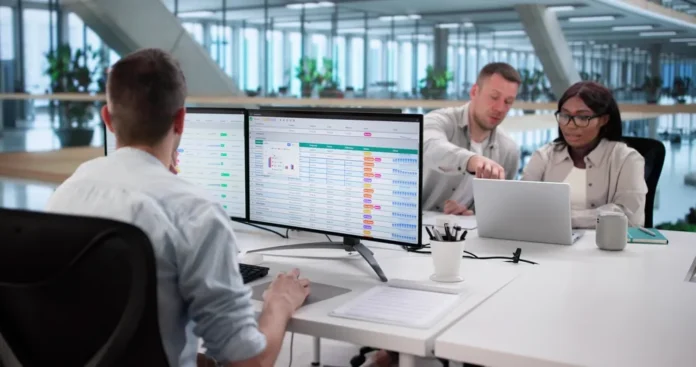
The persistence of spreadsheets in HOA operations is, in Hamidi’s view, a direct result of this integration failure. When no single platform captures the full operational picture, managers and board members default to their own tracking systems. This creates parallel, incompatible records that diverge over time.
“I’ve got my spreadsheet as a board member, then the manager has their own spreadsheet. It’s just a mess,” Hamidi says.
Board members reviewing a capital expenditure proposal may be working from data that is weeks or months out of date. Managers preparing for board meetings spend significant time assembling information that should be immediately accessible. The manual reconciliation process introduces errors, delays, and gaps that undermine the reliability of the information used to govern communities.
For homeowners paying into HOA reserves, this matters directly. Decisions about maintenance spending, vendor selection, and capital planning are being made from manually assembled, often outdated records, regardless of how capable individual managers and board members may be.
Point Solutions Backfire
Hamidi argues that the industry’s approach to technology adoption has deepened the fragmentation problem. Rather than building integrated platforms, software developers have targeted individual pain points. This has created tools for specific functions that don’t communicate with the rest of the operational stack.
A manager using four separate applications does more context switching, more manual data transfer, and more reconciliation work than a manager using one integrated system, even if each application is technically superior to the one before it. Digitization has added complexity without reducing the coordination burden.
Hamidi notes that some established players in the HOA management software space, including SYNC Systems, Frontsteps, and Vantaca, are moving to integrate AI capabilities into their platforms. However, she suggests that layering AI onto systems that are already difficult to navigate may not address the core problem.
“The systems that are going to be successful and maintain adoption are going to be systems that are going to have a more user-friendly interface,” she says.
Closing the Integration Gap
The core issue, according to Hamidi, is that most maintenance platforms treat managers and vendors as separate audiences instead of connecting both sides of the same workflow. When managers and vendors operate on disconnected systems, information must be manually re-entered and re-confirmed at every handoff, thereby recreating the same fragmentation described earlier in the reporting process itself.
Some platforms, including ON Property Technologies’ ON Call Pro and ON Field Pro, have attempted to address this by linking maintenance requests, vendor dispatch, documentation, and reporting into a single workflow. The underlying principle is that a forthcoming inspection module would let defects identified during property walkthroughs convert directly into work orders or bid requests, removing a manual step that currently requires managers to re-enter the same information across multiple systems.
“It creates this ecosystem of understanding of the community’s maintenance at any given point,” Hamidi says.
Whether this kind of integration delivers on its promise will depend on adoption in practice. Hamidi says certain customizations, such as support for preferred vendor lists and not-to-exceed spending limits, only emerged after real managers began using the system, suggesting that integration requirements are still being worked out through use rather than being fully solved. For homeowners and board members evaluating their community’s technology, the underlying question remains whether their current stack provides a single, coherent view of maintenance status, or whether it still forces managers to assemble that picture manually from disconnected sources.
About the Expert: Sally Hamidi is Founder and CEO of ON Property Technologies, with 15 years of prior experience running her own HOA management company and a subsequent executive role overseeing a large HOA portfolio at a national maintenance and construction business.
This article is intended for informational purposes only and does not constitute legal, financial, or investment advice. The views and opinions expressed herein reflect those of the individuals quoted and do not represent an endorsement of any company, product, or service mentioned. Readers should conduct their own due diligence and consult qualified professionals before making any investment decisions.

