
Portland’s housing targets are falling short, and the gap has less to do with political will than with development economics that fee waivers alone cannot fix.
Portland set a target of 6,000 new housing units annually through 2032. Last year, the city produced 1,652, according to Amirah Fattom and Kadoh Swiatkowski, co-founders of Amika Development. The two say the gap reflects a mismatch between housing policy and the actual costs of building smaller, denser projects in infill locations.
Policy Outpaces Market Economics
Cities can create regulatory pathways and waive fees, but if the underlying economics don’t work, developers won’t build. For years, system development charges, fees levied on new construction to fund public infrastructure, created a barrier to infill projects in Portland. Swiatkowski says these charges made smaller, denser projects economically unviable. As a result, developers built larger apartment complexes instead, where per-unit costs could be spread more broadly.
The fee structure also shaped what got built. When SDC waivers were previously tied to affordability thresholds, specifically units selling under $450,000, developers were forced to build extremely small to qualify. “They had to make the units small, about 800 square feet, 700 square feet, maybe even smaller,” Swiatkowski says. The result was a cottage cluster market constrained not by demand but by the economics of qualifying for a fee waiver.
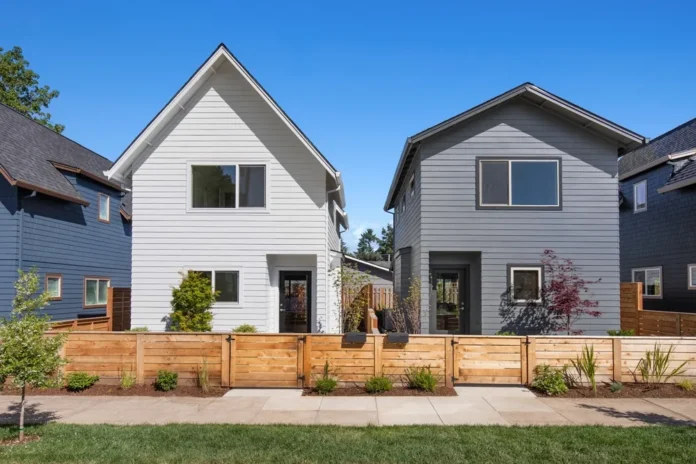
Portland’s temporary waiver of SDC fees, which Swiatkowski says is set to expire in 2028, changed that calculus. She says it removed the size constraint entirely, making it feasible to build on land that previously wouldn’t have penciled out. Amika Development’s current cottage units run 1,200 to 1,500 square feet, a size that wouldn’t have been financially viable under the previous fee structure.
Permitting Delays Squeeze Margins
Even with SDC fees removed, Portland’s permitting timeline remains a drag on development activity. Swiatkowski estimates that projects in the Portland metro area take six to eight months to move through permitting, considerably longer than in surrounding cities. For developers carrying land costs during that window, the math deteriorates quickly.
“If you own that land and you’re paying on that monthly, that can add up quickly,” Swiatkowski says. The carrying cost problem is particularly acute for smaller infill developers who lack the capital reserves of larger institutional builders. A permitting delay of this length adds real risk to any project requiring a few hundred thousand dollars in pre-permit capital, and many developers choose not to absorb that risk.
This dynamic helps explain why the city’s unit production remains dominated by apartment construction. Larger developers building at scale can absorb permitting delays more easily. Smaller infill developers, the ones most likely to build cottage clusters and missing middle housing, face a tighter environment. Delays have an outsized impact on whether these projects get built at all.
Portland’s Two-Tier Housing Gap
What Fattom and Swiatkowski describe in Portland is a bifurcated housing market. Apartments are being built at scale by larger developers. Historic single-family homes in established neighborhoods sell for north of $1 million. In between, there’s a gap.
“You’ll see that there are condos that are priced low, but you don’t get access to a backyard. You’re on the same floor as 13 other people,” Swiatkowski says. “Or you get homes that are historic and beautiful and big, and they’re 3,000 square feet and priced at a million dollars.” The missing segment is attainable housing with outdoor space in established neighborhoods, precisely what cottage clusters are designed to fill.
Swiatkowski notes that cottage clusters are the second-highest production category for new housing in Portland right now, behind apartments. That ranking, alongside the city’s shortfall against its targets, suggests the segment is underdeveloped relative to demand.
Offsetting Costs Through Partnerships
The landowner partnership model Fattom and Swiatkowski use points to one way developers are adapting to the carrying-cost pressures described earlier. Instead of purchasing land outright, landowners contribute the land itself, the developer contributes development expertise, and profits are split based on relative contributions, ranging from 50/50 to 70/30 depending on how much capital is invested. “We’re able to reduce our cost of development by getting that land donated to us,” Swiatkowski says.
Fattom says landowners who enter these arrangements often don’t initially recognize the development potential of their property. “They’ll go in thinking, okay, we can only build one home,” Fattom says. “And then if we come in and say, actually, you can put six cottages or a set of townhomes on it, that changes what they thought was possible.”
Whether this model can scale enough to meaningfully close the unit gap remains an open question. It addresses one piece of the cost equation, capital carried during permitting, but does not resolve the permitting timeline itself.
If Portland hasn’t built a pipeline of infill developers before the SDC waiver expires, the economics of smaller projects could revert to their previous constraints, and the city’s annual target will remain out of reach.
About the Experts: Kadoh Swiatkowski and Amirah Fattom are co-founders of Amika Development, a Portland-based firm specializing in cottage cluster infill development through landowner partnerships, with projects in the Portland metro area and expanding to other markets.
This article is intended for informational purposes only and does not constitute legal, financial, or investment advice. The views and opinions expressed herein reflect those of the individuals quoted and do not represent an endorsement of any company, product, or service mentioned. Readers should conduct their own due diligence and consult qualified professionals before making any investment decisions.

