
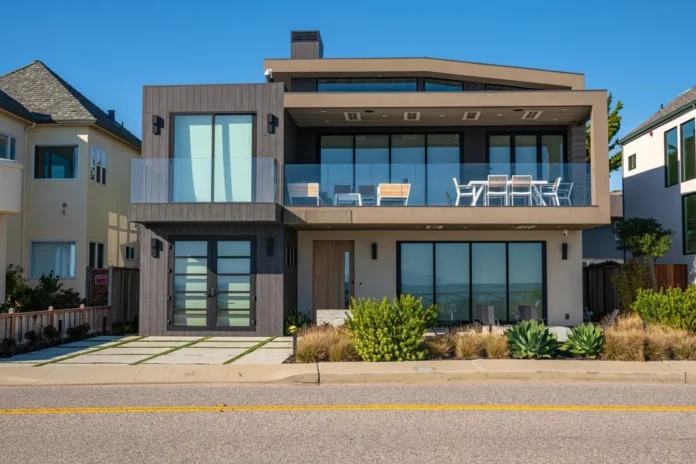
The January 2025 Los Angeles wildfires destroyed approximately 14,000 homes across Malibu, Pacific Palisades, and Altadena. The rebuilding conversation has focused on speed and cost. According to Ahmed Mahil, Founder, CEO & Global President of Luyten 3D, that framing misses the more important question: whether the homes being rebuilt will survive the next fire any better than the ones that burned.
Mahil argues that California’s dominant residential construction method, wood framing covered with stucco, is more than vulnerable to fire. It represents a structural mismatch between the materials used and current climate conditions.
Wood and Stucco Fail
Mahil describes standard California residential construction as a “stucco, cookie-cutter paper wall kind of design.” Wood-framed homes with stucco exteriors can meet current building codes and still be highly vulnerable to extreme wind and ember spread, the conditions that defined the 2025 fires.
In Mahil’s assessment, the fires exposed a systemic failure, not an isolated disaster. “There is no fire department that can fight such conditions,” he says, referring to the high winds that drove embers to spread rapidly across entire neighborhoods. Fire suppression alone cannot solve the problem. The materials themselves need to change.
Concrete, Mahil argues, is the most fire-resistant widely available building material. The challenge has never been concrete’s performance. It has been the cost and complexity of using concrete for residential construction.
Why Concrete Costs More
Mahil identifies formwork, the temporary molds required to shape poured concrete, as the primary barrier keeping concrete out of most residential construction, limiting it mainly to commercial and infrastructure projects. “The key thing is the cost of the formwork, 60%, and getting it straight, right, and past inspectors. It’s not as easy as putting bricks,” he says. “You need to vibrate the formwork, make sure there is no honeycombing. It’s just a tedious process.”
Despite concrete’s fire resistance and strength, this cost barrier has pushed residential construction toward wood framing, which is faster and cheaper to build with available labor. The result, according to Mahil, is a housing stock systematically under-built for the conditions it now faces.
He also points to energy performance as an underappreciated benefit. Concrete walls provide thermal mass that reduces heating and cooling loads. 3D-printed concrete can also incorporate design features, such as perforations, staggered surfaces, and geometric variation, that improve natural light and acoustic performance in ways standard framing cannot match economically.
A Live Market Test
Luyten 3D and its California partner, Concreta 3D, are treating the wildfire rebuild as a live test of that argument: can concrete be built into everyday housing in a market that needs both speed and affordability? The partnership spans both ends of that market, from high-end custom homes in Malibu and Pacific Palisades to social housing in Altadena, so the test isn’t limited to buyers who can absorb higher costs.
Mahil frames the work as evidence, not a demonstration project. “As we go forward, we need to build more resilient houses,” he says. “And concrete is the most resilient material worldwide. It can resist the fires and prevent their spread.”
For homeowners rebuilding in fire-prone areas, the choice between wood framing and concrete construction is no longer purely a cost calculation. Insurance underwriting, permitting timelines, and developer willingness to adopt unfamiliar methods will all shape how quickly concrete alternatives gain traction. But Mahil’s core argument is now being tested in the communities where 14,000 homes no longer stand: the fires made the case for different building materials in a way no policy debate previously could.
About the Expert: Ahmed Mahil is Founder, CEO, and Global President of Luyten 3D, an Australian robotics company with operations in California specializing in construction 3D printing technology.
This article is intended for informational purposes only and does not constitute legal, financial, or investment advice. The views and opinions expressed herein reflect those of the individuals quoted and do not represent an endorsement of any company, product, or service mentioned. Readers should conduct their own due diligence and consult qualified professionals before making any investment decisions.

