
The self storage industry has spent decades operating on a straightforward model: build it, fill it, collect rent. But a new generation of operators is bringing a technology-first mindset to what has traditionally been a low-tech business, and the results are showing in how facilities are run, how customers are served, and where the next opportunities are being found.
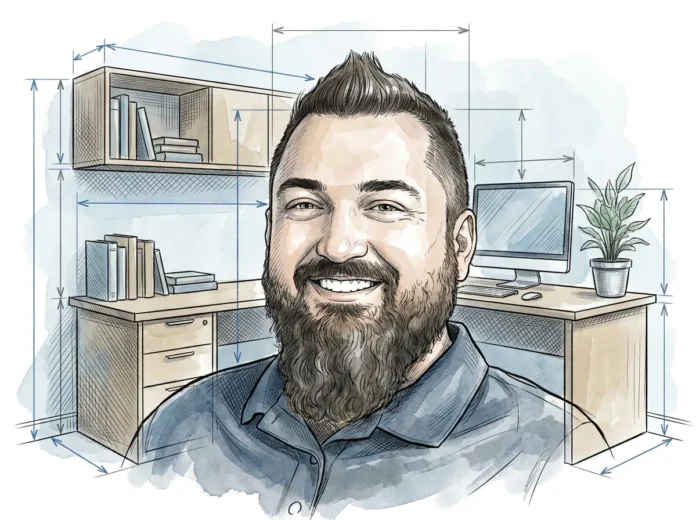
Alex Straffin, owner and operator of SpaceVault Self-Storage in Lafayette, Indiana, came to the sector from a software background, not real estate. That perspective shapes how he thinks about everything from customer experience to property management – and it points to a growing divide between operators who are adopting automation and those who are not.
Finding the Market
Straffin’s path into self storage was not a straight line. He started in residential real estate investing but found the pace frustrating in a high-rate environment. After exploring franchise options and finding none that fit, he and his partners began looking at commercial real estate more broadly.
The turning point came at an ISS conference (Inside Self Storage World Expo) in Las Vegas, where the scale of the self storage opportunity became clear. What followed was a deliberate search for the right market, not just the right property.
Lafayette caught his attention for a specific reason: Purdue University. The school has posted record enrollments multiple years in a row, creating steady population growth that supports demand for storage. That kind of institutional growth driver, Straffin argues, is exactly what operators should look for in secondary markets. “As long as you have a really strong drive of people pushing into this region, it’s going to continue to grow,” he says.
The property they acquired was a significant turnaround project – mismanaged, under-maintained, and plagued by security issues. It took roughly six months to stabilize. That experience has since become a template for future acquisitions.
The Technology Lens
What distinguishes Straffin’s approach is less about the real estate itself and more about how technology is layered on top of it. His partners all come from technology backgrounds, and that shapes how they evaluate problems and build solutions.
The facility currently operates with an unmanned office. Customers can pull up, scan a QR code, book a unit, receive their gate and lock codes, and begin storing their belongings within minutes. Move-out tasks are automatically dispatched to on-site staff through a mobile app, removing the need for manual coordination.
On the security side, AI-powered camera monitoring can distinguish between routine activity and behavior that warrants attention – a meaningful upgrade from basic motion detection. The system can trigger alerts or escalate to emergency services when it detects unusual after-hours activity.
The AI call center may be the clearest example of where Straffin sees the industry heading. Customers who call in at any hour reach an AI support representative that handles account lookups, payments, unit rentals, and reservations. For a business model built on lean operations, that kind of automation has a direct impact on margins. “When a customer calls in, 24 hours a day, 365 days a year, they get our AI support rep,” he says.
Straffin is also experimenting with IoT devices at the unit level, including low-powered environmental monitors that detect humidity and temperature changes – a real concern in Indiana winters where concrete condensation can damage stored goods. He is also developing in-unit customer support buttons that would allow renters to flag an issue without calling in or walking to the office.
Rethinking Property Software
One of Straffin’s sharper critiques targets the property management software platforms that most storage operators rely on. His view is that the dominant players have tried to do too much and ended up doing none of it particularly well.
“These are incredibly simple businesses,” he says. “They make them very complex because they’re trying to do everything, but you don’t need to do everything. You need to do something extremely well.”
He sees operators increasingly moving away from all-in-one platforms toward best-in-class tools that integrate through open APIs. “If you’re not integrating with an open API or AI, you’re going to get left in the dust,” he says.
This modular approach – picking specific tools for specific problems rather than defaulting to a single vendor – reflects how technology-forward operators are building their systems. The falling cost of development, accelerated by AI, means that custom solutions that once required months of engineering work can now be built and tested in days.
Secondary Markets Opportunities
Beyond the technology angle, Straffin’s focus on secondary markets reflects a thesis gaining traction among smaller operators. Major metro markets present high barriers to entry, both in terms of land costs and the capital required to build climate-controlled, multi-story facilities. Secondary markets with clear population drivers – a university, a major employer – offer better entry points and less competition.
His plan is to replicate the model. Lafayette sits roughly 65 miles northwest of Indianapolis in a historically manufacturing-heavy region. But with Purdue’s growth and the broader trend of remote workers distributing out of major cities, that profile is changing. “Property values are cheap, and there’s a good amount of income and money,” Straffin says. “It’s a really good market.”
What Comes Next
The gap between what current technology enables and what most storage operators have actually implemented represents the core opportunity for the next few years, according to Straffin. AI-powered customer service, automated facility management, and modular software stacks are all available now – but adoption across the industry remains slow.
“There’s so much that can be done now that couldn’t even two years ago,” he says. “If you’re not absolutely full blast on AI and automation right now, you’re going to fall behind.”
For investors and operators watching the self storage sector, the fundamentals – steady demand, relatively low operating costs, and a straightforward value-add model in secondary markets – remain intact. What is changing is the ceiling on how efficiently a facility can be run and how much of the customer experience can be delivered without a person physically present. Operators who treat that capability gap as optional may find themselves at a disadvantage sooner than they expect, particularly as technology-native competitors enter with lower overhead and faster response times.
About the Expert: Alex Straffin is the owner and operator of SpaceVault Self-Storage in Lafayette, Indiana, with a background in software and residential real estate investing prior to entering the self storage sector. His facility operates as a technology-forward, unmanned operation serving the Lafayette and Purdue University market.
This article is based on information provided by the expert source cited above. It is intended for general informational purposes only and does not constitute legal, financial, or real estate advice. Readers should conduct their own research and consult qualified professionals before making any real estate or financial decisions.