
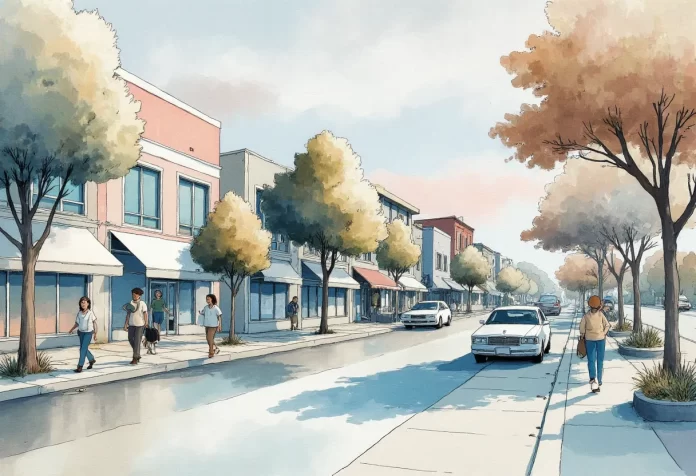
A clear pattern is developing in mature suburban real estate markets around major cities, according to Sarah Peters, Team Leader at eXp Luxury Realty. Walkability has moved beyond a lifestyle perk to become a decisive factor in pricing, changing the competitive landscape and limiting access for some buyers.
“We’re seeing major trends with baby boomers right now,” Peters says. “The communities that are performing the best are those with great walkability, where people can just go for a walk and experience something, go to dinner, but they’re just walking. Anywhere within walking distance to a borough, we’re seeing those homes are in very high demand.”
The Walkability Premium in Practice
Peters bases her observations on her team’s recent performance in Bucks County, Pennsylvania, where they closed 76 transactions totaling over $50 million in 2025. The county’s historic boroughs—including Doylestown, New Hope, and Newtown—feature pedestrian-oriented main streets with dining, shopping, and cultural amenities dating back to pre-Revolutionary War settlement.
According to Peters, homes within walking distance of these established town centers are selling faster and at higher prices than similar properties in car-dependent areas. Even when size, condition, and school districts are comparable, buyers are willing to pay a premium for walkability. This premium has remained consistent over time, giving these neighborhoods a lasting pricing advantage.
“Buyers are becoming more discerning at this moment,” Peters notes. “Pricing remains high, days on market have grown a bit, and that shows buyers are willing to wait. It also shows people aren’t rushing in, and it’s not all multiple offer bidding wars.”
The exception, she says, is turnkey, move-in-ready properties in walkable locations. These still attract strong interest and competitive offers on opening weekend, even as the overall market has cooled.
The Affordability Displacement Effect
Sustained demand for walkable neighborhoods is making it difficult for first-time buyers to compete in established boroughs. Peters points to parts of northern and southern Bucks County as more affordable alternatives. “For a lot of the first-time buyers, we help them identify these pockets that are very much within their reach,” she says.
However, in core boroughs like New Hope, Doylestown, and Newtown, prices have reached levels that effectively exclude most first-time buyers. “The prices have really reached a point where it’s not affordable for first-time buyers and for a lot of buyers,” Peters says.
This has led to a displacement effect, pushing buyers toward “up and coming” communities that aim to replicate the appeal of established walkable town centers. “We’re able to find communities that are kind of a little up and coming that almost replicate some of the quaintness and the proximity, but it’s still very much within their reach,” she explains.
Whether these emerging communities can recreate the genuine walkability that drives demand—or if they will remain car-dependent suburbs with only superficial pedestrian features—remains uncertain. As buyers look beyond premium-priced neighborhoods, the distinction between authentic and artificial walkability may become more pronounced.
Why Walkability Matters Now
This trend is gaining momentum at a time when suburban development has long prioritized car access and parking over pedestrian infrastructure. Peters reports that buyers are now showing a clear preference for neighborhoods that reduce car dependence, cutting across traditional demographic lines.
While baby boomers looking to simplify their lives make up a significant portion of buyers, Peters says younger buyers and families are also seeking walkable communities. The willingness to pay more for pedestrian access indicates that buyers are reevaluating what they value most in a home’s location.
This shift is affecting how properties are priced and marketed. Peters says her team’s high transaction volume—placing them in the top 1% of agents in their market—gives them an intense read on real-time buyer behavior. “Because of the amount of sales we do, we really can predict buyer behavior going into a weekend,” she says.
The Market Positioning Challenge
For sellers in walkable neighborhoods, this trend brings pricing power and a competitive edge. For those in car-dependent areas, it poses challenges for property positioning and setting realistic price expectations.
Peters says her team addresses this through detailed market education. “We’re able to educate our sellers by saying, here’s the national trends that don’t really apply to us. Here’s the hyperlocal trends that apply within three miles of your property or even within your neighborhood,” she explains.
The impact of walkability is highly localized. Properties just a few streets apart can experience very different market dynamics based solely on how easily residents can reach commercial districts and amenities on foot. This level of variation requires agents to have deep local knowledge.
Broader Implications
If trends in Bucks County reflect broader patterns, the implications for suburban development and municipal planning are significant. Communities that have invested in genuine town centers, mixed-use development, and pedestrian infrastructure may see sustained demand and price premiums.
By contrast, car-dependent developments that lack authentic walkability may face ongoing challenges in resale value, especially as more baby boomers and remote workers seek lifestyle amenities within walking distance.
An Emerging Pattern
Peters’ team has adapted by developing expertise in distinguishing neighborhoods with objective walkability from those with only surface-level pedestrian amenities. “There’s still affordability throughout Bucks County for anyone, if they’re open to being adaptable,” she says.
Whether the walkability premium will persist if interest rates decline and inventory rises in 2026 remains to be seen. Peters is optimistic, suggesting that lower rates could bring more buyers and sellers into the market. The coming year will show whether walkable neighborhoods continue to command a premium or if increased inventory and lower rates begin to narrow the price gap.