
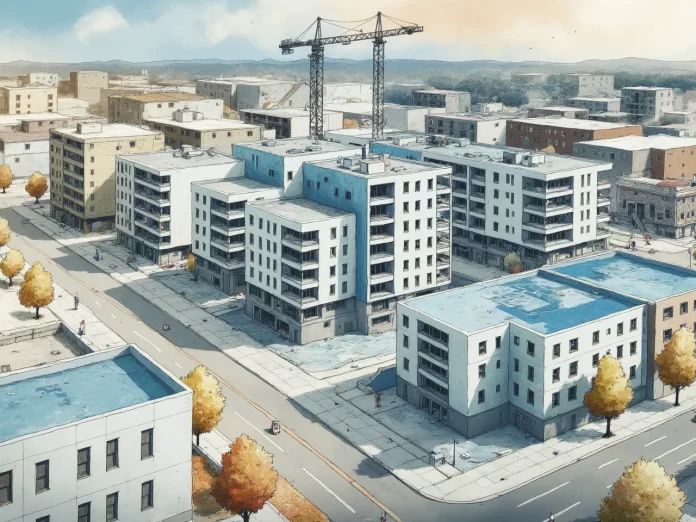
Farmington Hills, a suburb of Detroit, is undergoing a wave of new development, marked by three major projects: the demolition and rebuild of a shopping center, a 76-unit condo development on a long-vacant orphanage site, and a series of office-to-residential conversions along one of metro Detroit’s most affluent corridors. Construction cranes are now a common sight in the city, signaling a clear shift in the local real estate landscape.
Why is so much building happening now? The answer is straightforward. Farmington Hills has changed its approach, moving from a restrictive stance to a proactive one. Instead of relying on outdated zoning rules and lengthy approval hurdles, the city updated its master plan, rezoned key corridors, and streamlined the review process to actively encourage projects that align with market demand.
What Sparked the Change
Recently, Farmington Hills took an uncommon step: it listened to its residents. It analyzed post-pandemic market data to understand what people wanted and where market demand exceeded supply. The city’s economic development team reviewed consumer traffic patterns and found that residents wanted more restaurants, walkable retail spaces, and diverse housing options near employment centers. At the same time, office landlords faced rising vacancies as remote work reduced demand for traditional office space. Many developers were interested in repurposing these spaces, but found outdated zoning rules made approval difficult.
In response, the city implemented several key changes. It rezoned Twelve Mile Road — a corridor home to major employers like Bosch, Nissan, and Akebono — to permit both commercial and residential uses alongside offices. The city also streamlined the project approval process and introduced free pre-development meetings. These meetings bring together developers and representatives from every city department to review site plans and provide feedback before any formal submission.
“We provide them the opportunity without a cost to have that discussion as many times as it takes,” says Cristia Brockway, the city’s Economic Development Director. “That way, they can submit their plans the first time with their best chance of approval.”
What’s Being Built
For instance, Hunter Square, a dated shopping center on Orchard Lake Road, is being redeveloped. The northern section has been demolished to make room for a Meijer grocery store, Total Wine, Nordstrom Rack, and new street-facing restaurants. The redesign reduces the parking lot’s size and introduces a walkable, community-focused layout — departing from the car-centered shopping mall model that dominated suburban development for decades. “It’s going to have a much greater community feel than it ever has before,” Brockway says.
Another significant project is The Village at Pebble Creek, a 76-unit condominium complex on the site of the former Sarah Fisher Center. The property had been vacant and deteriorating for years. The new developer is cleaning up environmental contamination, preserving a historic chapel for community use, and bringing new families to an area that had long been neglected. “It’s a huge win for Farmington Hills,” Brockway says. “New families, cleaned-up contamination — it’s a fantastic opportunity.”
In addition, developers are pursuing office-to-residential conversions along Twelve Mile Road. With the updated zoning, they can add ground-floor retail, convert upper floors to apartments, or create mixed-use buildings without needing variances or special approvals.
Developer Interest
So, what’s drawing developers to Farmington Hills? The city’s demographics and spending power are key. Along Grand River Avenue, Farmington Hills has 120,000 residents and 45,000 workers within a five-minute drive, creating a substantial customer base for retail, dining, and services. City estimates show $30 million in untapped consumer spending potential along that corridor, and $100 million in existing retail household spending.
On Orchard Lake Road, which serves as the city’s international dining and shopping district, foot traffic has increased by 10 percent in recent reports. The city expects this growth to continue as more people are drawn to the area’s diverse restaurants and unique retail offerings. “The demand is phenomenal,” Brockway says. “We’re seeing strong local support, and the corridor is increasingly attracting visitors from across the region.”
This combination of strong market fundamentals and a city government actively working to simplify development makes Farmington Hills more attractive to developers than many surrounding communities.
What to Watch
The Outlook
The more important test will come over the next several years, as these projects move from groundbreaking to occupancy. If the new retail, residential, and mixed-use developments lease up quickly and generate sustained foot traffic, they could reinforce the city’s strategy and encourage additional investment along key corridors. Success would not just mean new buildings, but a measurable shift in how people live, work, and spend time in Farmington Hills.
Brockway believes the groundwork has been laid for that next phase. “We’re open for families, we’re open for businesses,” she says. “If people are looking to make a move, it should be in Farmington Hills.”
About the Expert: Cristia Brockway is Director of Economic Development for the City of Farmington Hills, Michigan. She specializes in business attraction, corridor revitalization, and community-driven development.
This article provides insights into development trends in Farmington Hills and does not constitute legal, financial, or investment advice.