
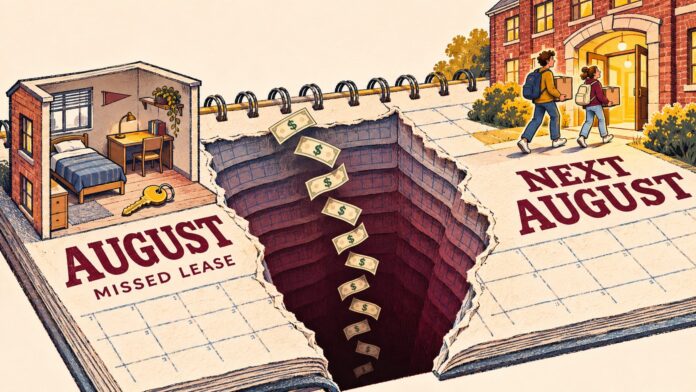
In student housing, a property’s year is often decided within a few short windows. Students choose where to live during concentrated decision periods, and once they sign somewhere else, that demand does not come back later in the cycle.
Teddy Abdelmalek, SVP of Business Development at HH Red Stone, says this compressed calendar is one of the defining realities of student housing property management. “A single missed leasing window can define an entire year,” he said. For owners, understanding how the calendar works is central to protecting occupancy, rental income, and net operating income.
Why A Missed Leasing Window Is So Costly
When a property falls behind its competitors on preleasing, the options for catching up are limited and expensive. According to Abdelmalek, the property that falls behind may eventually have to rely on heavier concessions, lower rates, or more marketing spend.
“A missed leasing window does not just affect occupancy,” he said. “It can affect rental revenue, concessions, marketing costs, and ultimately NOI for the full year.”
The way the team operates also changes. Abdelmalek says a team that is behind the calendar becomes reactive instead of strategic. Instead of setting pricing, it responds to competitors. Instead of using concessions selectively, it uses them because occupancy is behind. Instead of hiring ahead of turn, it scrambles for labor during the busiest period of the year.
“Once a team gets behind, the property often pays a premium for being late,” he said, pointing to overtime, concessions, added marketing, higher vendor costs, and lost revenue. “The calendar rewards preparation and punishes hesitation.”
Turn Season Is Won Months In Advance
Turn season, the stretch between move-out and move-in, is one of the most demanding periods of the student housing year. Hundreds of residents may move out within days. Every unit then has to be inspected, repaired, cleaned, painted, and prepared for the next resident.
Vendors need to be coordinated, damages documented, furniture repaired or replaced, and quality checked, all against a move-in date that will not change. “You cannot ask the university to delay the semester because your units are not ready,” Abdelmalek said.
His advice is to treat turn as a planning project rather than a summer scramble. “The best turn seasons are won months in advance through planning, staffing, purchasing, and clear accountability.” In practice, that means lining up vendors early, ordering materials ahead of time, and making sure every task has a named owner before the first resident moves out.
Preleasing Is A Year-Round Discipline
Many people assume preleasing starts when the leasing season visibly picks up. Abdelmalek says strong operators start much earlier, often while the current cycle is still underway.
At that stage, his teams review which floor plans leased first, where the property may have left money on the table, when concessions became necessary, how competitors are positioned, when renewals should launch, and what opening rates should be.
“By the time the market visibly heats up, much of the strategy should already be in place,” he said. “Preleasing is not a short campaign. It is a year-round operating discipline.”
For owners, this points to a simple question worth asking any management company: what are you doing right now for next year’s leasing cycle?
Building A Team That Keeps Pace With The Calendar
Urgency matters in student housing, but Abdelmalek is clear that it should come from clarity, not chaos.
His approach starts with a visible scoreboard. The team should know the final occupancy goal and also where the property needs to be at specific points throughout the leasing cycle. Each key outcome needs a clear owner, including renewals, outreach, turn readiness, delinquency, reputation, and leasing velocity.
“Strong leaders create urgency through clarity and accountability, not chaos,” he said. “The best teams move quickly because they understand what matters, who owns it, and what the deadline is.”
Owners comparing student housing property management companies can use these points as a checklist. A capable operator should be able to show its prelease targets by month, its turn plan and vendor schedule, and who on site is responsible for each part of the leasing cycle. Owners can learn more about HH Red Stone’s third-party services on its property management page.
HH Red Stone is the property management arm of HH Group, managing approximately 10,000 beds across multiple asset classes including student housing, multifamily, affordable, and mixed-use properties nationwide. After a decade of exclusively managing HH Group’s owned portfolio, the company launched its third-party management vertical to serve other owners with the same institutional-grade approach it applies to its own assets. HH Red Stone’s operating philosophy centers on “functional hospitality,” treating residents as CEOs and maintaining operations with the discipline and consistency that drives sustainable success. Website: www.hhredstone.com
This article is based on information provided by the expert source cited above. It is intended for general informational purposes only and does not constitute legal, financial, or real estate advice. Readers should conduct their own research and consult qualified professionals before making any real estate or financial decisions.
Disclosure: Individuals or companies mentioned may have a commercial relationship with KeyCrew.

