
For years, construction 3D printing has occupied a narrow lane: single-story demonstration homes, small community projects, and the occasional two-story residence. The technology has generated attention disproportionate to its actual output.
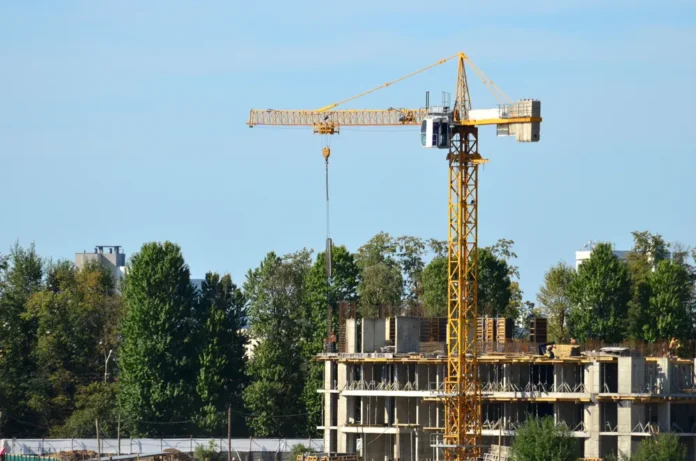
That is starting to shift. Companies in the space are now targeting multi-story and high-rise construction, the building type that accounts for the majority of urban housing worldwide, by integrating printing systems with existing tower cranes rather than engineering entirely new machines.
The move addresses a basic market reality. Most of the world’s population lives in vertical housing rather than detached single-family homes. A technology limited to low-rise construction, no matter how efficient, cannot meaningfully affect housing supply at the scale the global shortage demands.
The Crane Is the Entry Point
The logic behind mounting 3D printing systems onto tower cranes already present on construction sites, according to Ahmed Mahil, Founder, CEO & Global President of Luyten 3D, an Australian robotics company with operations in California, comes down to adoption friction as much as engineering cost.
Purpose-built cranes would carry a price tag that undermines the economics of the whole approach. Construction, Mahil says, is “a risk-averse and technology-resistant industry.” Introducing an unfamiliar machine onto a job site creates resistance. Integrating new capability into equipment crews already use daily reduces it.
Crane-mounted systems can tie into existing crane safety protocols, including weather vanes that trigger the printing apparatus to retract when wind speeds reach certain thresholds. When conditions exceed safe limits, the printing component withdraws, and the crane follows the wind rather than resisting it.
Luyten arrived at this approach after building a line of gantry-style printers that max out at two stories. Mahil frames that earlier product line as a necessary step toward understanding the technical constraints of printing at height. “We realized that if you really want to solve the housing issue, it’s not just by building one-story or two-story houses,” he says. “The majority of the world actually live in these high towers.”
The Labor Shortage
The commercial case for construction robotics rests less on speed than on workforce economics. Mahil points to a generational shift in labor supply that affects markets from Australia to the United States.
“It’s very hard right now to find someone who’s 20 years old and says, ‘I want to be a bricklayer for 40 years like my grandfather was,’” he says. “Why would you be a bricklayer, going up in scaffolds, a very dangerous job, when you can just do Uber Eats or DoorDash, and it gets you the same amount of money?”
The implication for builders is a productivity argument: a crew that currently completes a handful of houses a year could, with the same overhead, complete significantly more using robotic systems. The underlying logic – that automation allows smaller crews to produce more output – mirrors what has already occurred in automotive and food manufacturing.
Mahil draws a pointed comparison: “You have way more industrial safeguards and quality control measures and protocols in your Coke can or Snickers bar than in buildings that are supposed to last for hundreds of years.”
Fire Risk
The technology also eliminates formwork, the temporary molds traditionally required for concrete construction. Formwork can account for the majority of conventional concrete construction costs. Removing it changes the economics of using concrete for residential buildings, a category historically dominated by wood-frame construction in the U.S. market. Traditional concrete methods have largely been restricted to commercial buildings and infrastructure precisely because of that formwork expense.
California’s fire risk adds another dimension to that argument. After wildfires destroyed thousands of houses in the state, the case for concrete as a fire-resistant building material has strengthened. “We need to build more resilient houses,” Mahil says. “Concrete is the most resilient material worldwide, and it can resist fires and prevent their spread.”
The precision robotic printing also opens architectural possibilities. Architects are among the technology’s strongest advocates, according to Mahil, because curved and complex designs that were previously cost-prohibitive to form in concrete become feasible when material is deposited layer by layer. Walls can be designed to reduce noise transmission, control sunlight exposure, or incorporate patterns that serve both structural and aesthetic purposes.
Where Adoption Stands
Early interest in crane-mounted printing systems has come from jurisdictions across Asia, Africa, the Middle East, Europe, and the Americas, according to Mahil, a breadth he attributes to the approach’s compatibility with cranes already in use globally.
“We decided not to reinvent the wheel,” he says. “Since this industry is very resistant, very skeptical, how about we bring them something that looks like something they know and integrate with something they work with very intimately.”
For developers who have watched 3D concrete printing from a distance, viewing it as a technology limited to demonstration projects and single-family homes, the crane-mounted approach removes the barrier that kept them out. The equipment is familiar. The safety protocols are established. The workforce required to operate it is smaller than what conventional methods demand. Whether adoption follows the pace of interest Mahil describes will depend on how the first multi-story projects perform once construction begins.
About the Expert: Ahmed Mahil is Founder, CEO, and Global President of Luyten 3D, an Australian robotics company with operations in California specializing in construction 3D printing technology.
This article is based on information provided by the expert source cited above. It is intended for general informational purposes only and does not constitute legal, financial, or real estate advice. Readers should conduct their own research and consult qualified professionals before making any real estate or financial decisions.