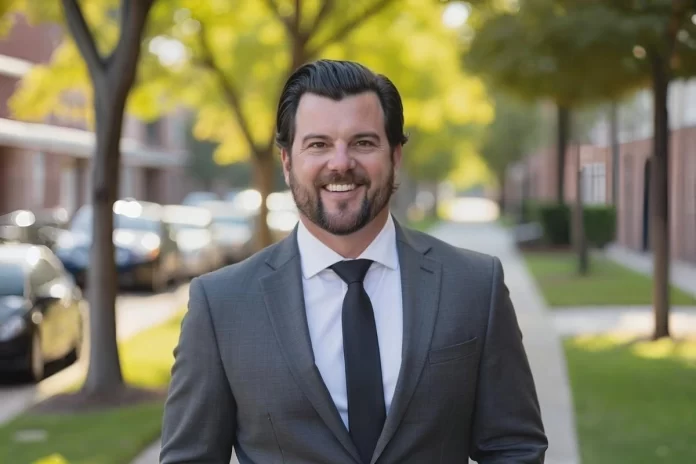
As commercial real estate development accelerates across Northwest Florida’s Gulf Coast, one construction leader is demonstrating how legacy thinking can inform modern project delivery. Kelvin Enfinger Jr., Vice President of Greenhut Construction and 2025 Chair of ABC Florida, brings a distinctive perspective to an industry often focused on quarterly results: what matters is what remains after construction ends.
The Local Knowledge Premium
Greenhut Construction’s competitive positioning centers on a straightforward value proposition – comprehensive local expertise translating to superior project outcomes. With major completions in 2025, including the Leonardo MRO hangar facility, Myrtle Grove Elementary School, and the American Magic Facility, the company operates primarily in healthcare, aviation, education, industria,l and office sectors.
Enfinger articulates the tangible benefits of local contractor engagement beyond marketing rhetoric. “When clients contract with us, they know that they’re contracting with a local general contractor who’s using local subcontractors who have local employees,” he explains. “We’re circulating those tax dollars back in the community.”
This localized approach has proven essential for decades, where this team regularly navigates budget obstacles, unique structure complexities, and local site conditions. The ability to leverage institutional knowledge of local conditions, permitting processes, and supply constraints delivers value that out-of-market contractors struggle to replicate.
Workforce Development as Competitive Strategy
As chair of ABC Florida – the state’s largest commercial construction association – Enfinger confronts industry-wide workforce challenges from a position of influence. His analysis of the skilled trades shortage focuses less on individual firm recruitment and more on systemic shifts in how society values different career paths.
“Generationally, we came through a time period where we promoted different career paths. We pushed a lot of kids into higher ed that probably didn’t need to be pushed into higher ed,” Enfinger observes. The resulting skills gap affects project timelines, costs, and quality across the industry.
His proposed solutions operate on multiple levels: direct advocacy through ABC’s Capitol Days, engaging Florida lawmakers, promotion of skilled trades as viable career paths offering competitive compensation without student debt, and partnership with educational institutions through advisory roles, including the University of West Florida’s Construction Management Advisory Council.
Notably, Enfinger frames workforce challenges through a technology lens. While artificial intelligence disrupts white-collar occupations, skilled trades offer inherent protection from automation. “What we won’t see in my lifetime is artificial intelligence being able to take the place of a plumber, electrician, or HVAC tech, carpenters, anybody that works with their hands,” he notes.
From Field Operations to Executive Leadership
Enfinger’s credibility on workforce issues stems from personal experience. His career progression from tradesman through various skilled roles to vice president provides operational insight uncommon in executive leadership. This background informs team deployment strategies across projects.
“You’ve got to know your people. You’ve got to know their strengths and weaknesses,” he explains regarding project staffing decisions. “Each one of our team members is unique and comes from a unique background. They have different experiences, whether it’s from the heavy civil side or maybe it’s from strong experience in concrete structure.”
This matching process – aligning specific project requirements with team member expertise – represents a competitive advantage in an industry where project complexity continues to increase.
Safety and Sustainability Beyond Compliance
Greenhut’s approach to safety and sustainability reflects Enfinger’s belief that these elements require genuine cultural commitment rather than checkbox compliance. “From the president of this company through me to every project manager to every superintendent, it is a consistent flow of information on how we approach it,” he describes.
The company maintains a full-time safety director whose role extends beyond regulatory compliance to active field engagement and culture reinforcement. “Every one of our team members has the same ideology and approach to safety, that is going to be the first thing that we’re going to assess on every project, every day with every task that we’re going to perform.”
Regional Market Dynamics
Northwest Florida’s commercial real estate market presents opportunities driven by economic development success. Enfinger observes significant growth in aerospace, manufacturing, and distribution sectors, supported by regional quality-of-life factors including Gulf Coast beaches and vibrant communities.
“Our economic development alliances throughout Northwest Florida are doing a terrific job of attracting new business and new talent into our community,” he notes. Available industrial land, combined with infrastructure capacity and lifestyle amenities, positions the region for sustained expansion.
For property owners and developers, Enfinger’s perspective emphasizes selecting contractors based on demonstrated local expertise, comprehensive service capabilities, and long-term community commitment rather than solely on initial bid pricing.
Policy Advocacy for Industry Advancement
Beyond project-level execution, Enfinger engages in construction policy advocacy. His primary concern is immigration reform – “ABC National is specifically working on a merit-based visa program facilitating legal workforce participation, and I am optimistic that we will make some progress in this area.”
“We have a lot of great men and women in this country who come here to work and provide a living, families that want to be a part of this great country,” he states. “For the ones that are here that are not bad actors and don’t have criminal records, I think we should be able to expedite their visas through a merit-based visa program.”
This advocacy recognizes construction’s dependence on immigrant labor while addressing legal and operational complexities affecting project delivery.
Infrastructure as Community Legacy
Enfinger’s definition of legacy projects extends beyond architectural significance to community impact duration. Healthcare facilities rank highest in his assessment – infrastructure delivering essential medical services for generations. Education facilities follow closely, representing long-term community investment in human capital development.
Greenhut‘s portfolio reflects this priority, including extensive work on Sacred Heart Hospital expansions, the original Pensacola Airport construction, and numerous educational facilities throughout the region.
“Northwest Florida is not just our home; it is our legacy,” Enfinger emphasizes. This perspective – viewing construction through multi-generational impact rather than project completion – distinguishes firms focused on community building from those treating development as purely transactional.
As commercial real estate markets navigate economic uncertainty, workforce constraints, and technological disruption, Enfinger’s approach offers a framework balancing growth with sustainability, innovation with proven methods, and profitability with community responsibility. The result: a product delivered not just for current utility, but for lasting regional benefit.
Disclosure: Individuals or companies mentioned may have a commercial relationship with KeyCrew.